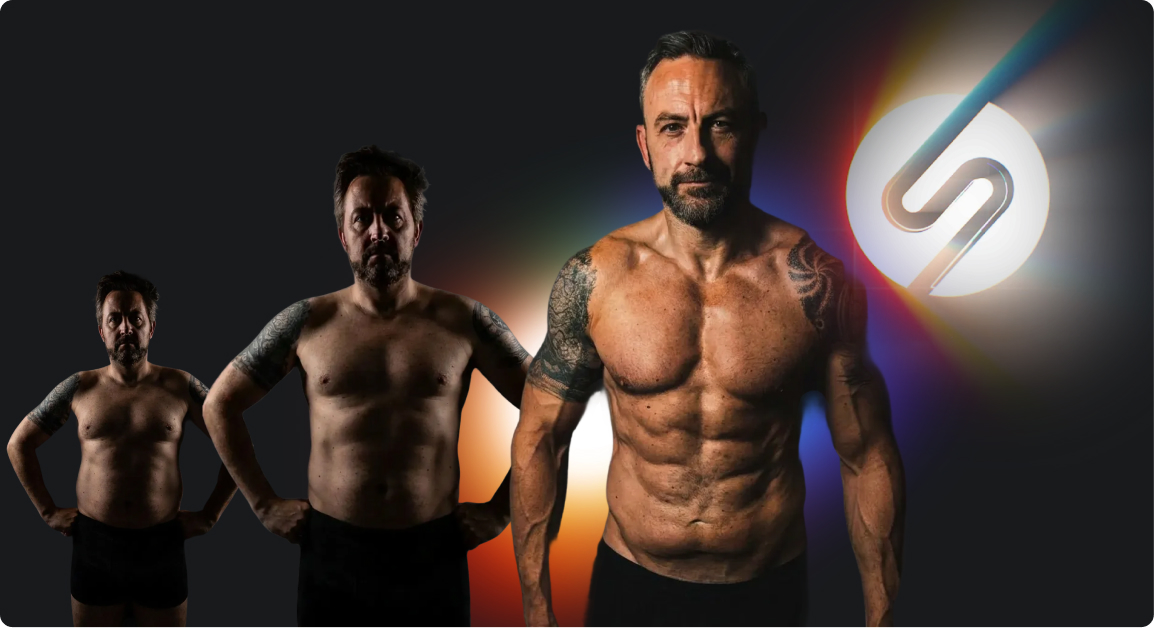
Tim didn’t join Supra Human because he didn’t know how to lose weight.
He joined because he knew how to lose the same weight every year.
His life looked like this:
- Lose twenty, thirty, even forty pounds.
- Hit a breaking point.
- Drift back to old habits.
- Regain everything he fought for.
Tim didn’t need another cut. He needed a strategy that didn’t send him straight back to where he started.
This is the part most diets never address. It’s the part that keeps 95 percent of people stuck in the same loop. It’s the part that turned Tim’s transformation from temporary to permanent.
That part is diet recovery.
Phase 1: The Cut Was Never the Real Story
When Tim started, he weighed around 230 pounds.
The first week wasn’t about overhauling his life. Instead, we simply observed it.
He tracked what he was already doing, and it landed around 1700 calories per day, likely lower than his true baseline, because people naturally tighten up when someone is watching. It still served as a great starting point.
His coach set a structured deficit, dialed in his steps, programmed training with intention, and created weekly accountability.
Over time, his weight trended down to 191–192 pounds on roughly 1450 calories.
On paper, this was a win:
- Down nearly 40 pounds
- Noticeably leaner
- Better energy and movement
- Clear changes in his face and frame
For most programs, this is the finale. Before. After. A trophy photo and goodbye.
For Supra Human, this was only the beginning. Because no one wants to live on 1450 calories and a punishing output forever.
And the truth is… no one can.
The Missing Chapter: After You Win, What Then?
Most people think dieting is the hard part.
It’s not.
Losing weight is a short-term challenge. Keeping it off is a long-term identity shift. That’s why nearly 95 percent of dieters regain the weight within three years. It’s not because they failed their diet. It’s because:
- There’s no exit strategy
- Old habits return the moment the diet ends
- The body rebounds when restriction stops
- No one teaches them how to create new, lasting habits
If you stay in an aggressive deficit forever, you burn out. If you jump straight back to your old baseline, you blow up.
What Diet Recovery Actually Is
The only sustainable way to maintain your weight loss is through diet recovery. So, what is that?
Diet recovery isn’t “eat freely and hope you don’t rebound.”
At Supra Human, it’s a structured phase designed to:
- Normalize hunger and satiety
- Restore energy, mood, and training performance
- Reverse metabolic adaptation
- Expand flexibility without the weight regain
- Establish a sustainable maintenance level
It’s the phase that protects the work you just earned. This is where Tim’s journey turned from “another cut” into a real transformation.
Phase 2: Tim Meets the Scale… and Himself
At the end of his fat loss phase, this is where Tim was at:
- Consuming around 1450 calories per day
- Weighing around 191.9 lbs
From here, he increased calories with intention.
Week 1–2: Increase to 1680 calories
The scale jumped 2.8 pounds.
This is the moment where most people panic.
They assume they’re gaining fat again and need to cut. But the math is clear.
To gain 3lbs of fat, Tim would have had to eat up to maintenance, then an additional 10,000 or more surplus calories. And all of those calories would need to be stored as fat.
Of course, that didn’t happen.
What did happen was:
- More food volume
- More glycogen stored in the muscles
- More water retained with that glycogen
This wasn’t fat gain. It was physiology. Tim looked tighter, healthier. Not worse.
So, we continued upward.
The Climb to Maintenance
Over 12 weeks, we nudged calories up.
1680 → 1760 → 1850 → 1900 → 2000 → 2100 → 2180 → 2350
Some weeks he gained a pound. Some weeks he lost one. Some weeks he stayed flat.
But something else happened: He looked leaner at 196 pounds than he did at 192.
Why? Because he was still in a small deficit for part of the climb, slowly refilling energy stores, restoring training output, and building muscle while approaching real maintenance.
Around 2350 calories, his body stabilized. His photos stayed sharp. His weight hovered around 195 pounds. His energy, strength, and mood normalized.
That’s maintenance, not the theoretical number from a calculator, but the number that matched the current version of Tim.
Phase 3: Rebuilding the Body and the Identity
Now came the choice: Stay ultra-lean? Or move into a surplus and build muscle?
Tim chose to build.
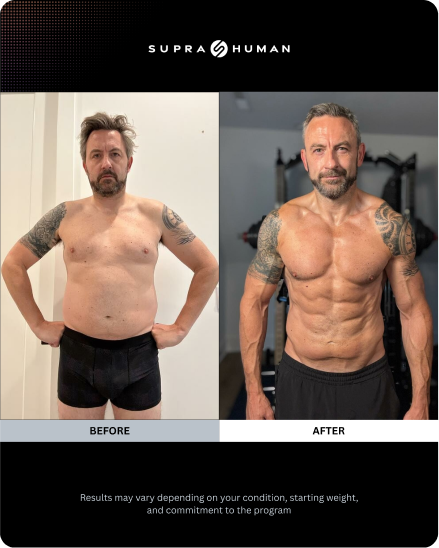
His calories rose to around 2600. His weight floated between 203–205 pounds.
This is where many people get confused by the scale. So, it’s important to listen to how you feel and use the mirror as a guide.
For Tim, that looked like a fuller chest and shoulders, powerful legs, and a lean but strong physique. He felt more like a man who owned his standard.
The goal is not to live at the extreme. The goal is to live as close to your best as possible while maintaining the habits that keep you there.
For Tim, that meant staying about 7-10 lbs above his leanest point, holding onto more muscle, having more energy, and a routine he could sustain for the long run. He was no longer yo-yoing up and down on the scale. He had a new baseline that he could live in every day.
What It Feels Like Inside the Supra Human System
People see the photos, but not the process.
Here’s what transformed Tim from a yo-yo dieter into a man with a standard:
1. Relentless, calm self-monitoring
Not obsession. Ownership.
- Daily weigh-ins
- Food tracked in a sustainable way
- Training logged with purpose
- Weekly check-ins for accountability
Data didn’t control him. Data gave him clarity.
2. Structured flexibility
He didn’t go “off plan.” He expanded the plan.
He could have the donut or a nice work dinner. He could enjoy the weekends.
All because he operated inside a bigger weekly structure, not a rigid daily prison.
3. He engineered his environment
Tim didn’t rely on willpower. He changed what surrounded him.
While traveling, he rented places with a kitchen so that he could prepare his own meals. He found the gym before he even unpacked.
At home, he built a home gym so training had no friction in his daily life and stocked up on high-protein, high-fiber foods.
4. He had a coach who told him the truth
When the scale spiked, his instinct was the same as anyone else:
“Cut me back down.”
His coach said: “No. You’re fine. Stay the course.”
This is the moment transformation actually happens. Not when the weight drops, but when you can hold the line when the scale tries to pull you back into old patterns.
He removed obstacles and created momentum.
The Traits That Keep Tim Lean for Life
Tim doesn’t stay transformed because of willpower. He stays transformed because of the systems in place.
Here are the traits he built:
1. Daily self-checks
He still weighs in. Still logs food. Data should be used as insight, not punishment.
2. Intelligent restraint
There’s no restriction, just structure. That means there may be lower calories on busy weekdays, higher calories on weekends, all to keep the weekly averages aligned with his goals.
3. Consistent training
He maintained four strength sessions per week and a daily step target.
No punishment. Just performance.
4. Long-term thinking
He makes decisions his future self would respect. Short-term feelings no longer dictate long-term outcomes.
5. Supportive environments
At home… on the road… every space he occupies now reinforces who he wants to be.
6. A simple, nutritious food foundation
He focused on consuming whole foods like lean proteins, high-fiber fruits and vegetables.
Processed foods aren’t banned, they simply no longer control the wheel.
What Tim Proves About What’s Possible
Tim is not a rare case. He is simply someone who stopped letting his old identity set the terms.
He became:
- A man with standards
- A man whose baseline is 30–40 pounds lighter
- A man who knows how to eat, train, travel, and live with control
- A man who no longer fears the scale
But most importantly, he became someone who understands:
Excellence isn’t found at the end of a diet.
Excellence is built in what you choose after it.
That is the Supra Human difference. Not just dramatic before-and-after photos, but a body, a process, and a standard you can live by day after day, year after year.
The pursuit doesn’t stop. Your old story does.
If you’re tired of losing the same weight over and over again, Tim’s journey is your proof:
You don’t need another diet. You need a strategy that lets you live in the body you earn.
And that’s what diet recovery makes possible.
If you’re ready to tackle diet recovery and transform your daily habits, our team of coaches is ready for you. Click here to see what’s actually possible.