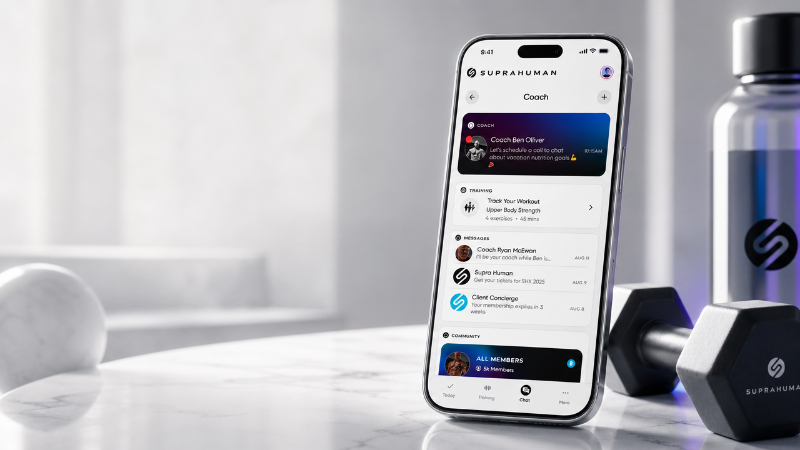
On July 7, 2026, we officially launched the Supra Human beta platform.
Watching clients download it for the first time was equal parts exciting and nerve-racking. After months of planning, debating, building, testing, and refining, the platform was no longer contained inside design files, development environments, internal meetings, and product demonstrations.
It was in the wild.
For our team, this launch represents a major milestone. But it’s far from the finish line. This is the beginning of a much larger evolution in how Supra Human delivers its client experience.
For the first time, we have the foundation to shape that experience from beginning to end.
Training, communication, accountability, coaching, progress, and future product capabilities can begin living within one connected platform rather than being distributed across separate systems.
More importantly, we now have something we can continue improving alongside the people who will actually be using it every day.
The purpose of a beta launch isn’t to deliver a product with every possible feature completed. The goal is to establish the right foundation, place it into a real coaching environment, gather meaningful feedback, and improve the experience with every release.
We’re proud of what we launched. But, we’re even more excited about what it now allows us to build.
The Work Behind Something That Feels Simple
Apps are everywhere.
From the outside, they often look remarkably simple. You download, create an account, tap through a few screens, and begin using it.
Building a product that feels that simple is usually anything but.
One area we refused to compromise on was the client onboarding experience.
Those first few minutes shape how someone understands a product. If the process feels confusing, clunky, or disconnected, the client begins their experience already carrying unnecessary friction.
We wanted the opposite.
The platform needed to feel clear from the moment someone opened it. The language needed to sound familiar. The screens needed to guide clients naturally. The visual experience needed to feel elevated without becoming intimidating or overly complicated.
So we kept refining it.
There were multiple versions, long discussions, healthy disagreements, and more than a few ideas that never made it beyond an internal review. We questioned the order of screens, the placement of buttons, the number of steps required, and the information we were asking clients to provide.
We rewrote language that was technically correct but didn’t feel human enough. We reconsidered layouts that looked good but added unnecessary effort. We simplified wherever the experience began asking the client to think too much about the platform itself.
Eventually, the onboarding experience began to feel like what we had envisioned: clean, intuitive, polished, and unmistakably Supra Human.
That same level of scrutiny shaped the rest of the beta.
A Product Built Across the Entire Company
The Supra Human platform may be a technology product, but building it never lived in just one department.
It required product management, engineering, design, marketing, branding, coaching, operations, and leadership to work together around the same experience. Each team approached the platform through a different lens, but all with the same end goal in mind.
Engineering focused on stability, security, scalability, performance, and the technical architecture required to support future growth.
Design focused on how clients move through the product, how information is organized, and how each screen communicates what should happen next.
Marketing and branding considered the language, visual identity, tone, colors, and small emotional signals that determine whether the product feels distinctly Supra Human.
Our coaches brought an equally important perspective. They evaluated the platform based on how it would function inside an actual coaching relationship.
Would this make an important piece of information easier to find?
Would this workflow save time or create another step?
Would the client understand what was being asked of them?
Would the platform make the coaching experience feel clearer, more connected, and more responsive?
Those questions helped prevent the product from becoming technology designed in isolation.
Every department had to understand not only whether a feature worked, but how it affected the person using it.
The Details Clients Feel Without Seeing

Some of the most important product decisions are nearly invisible.
The way a message is phrased can change whether it feels supportive or transactional. The way information is arranged can make a task feel effortless or exhausting. The placement of one button can determine whether a client moves forward naturally or pauses because they are unsure what to do.
These details may appear small when viewed individually. Together, they define the experience.
Our goal was to make sure that every aspect of this platform felt intentional.
That required us to look closely at every interaction, from the moment a client receives access to the moment they complete an action, communicate with their coach, or return to review their progress.
The most successful product experiences rarely announce how much work went into them.
They simply feel natural.
That is the standard we continue working toward.
Behind Every Screen Is an Entire System
The visible platform is only one layer of what we built.
Behind every screen sits a much larger technical structure involving account creation, login security, permissions, data management, integrations, connectivity, platform performance, and the infrastructure required to support future health information.
Clients shouldn’t have to think about any of that. But our product and engineering teams have to think about ALL of it.
We’re building beyond what would work today and instead building for what it will need to support several releases from now.
That means making technical decisions that allow new capabilities to be introduced without forcing the entire product to be rebuilt each time the vision expands.
It means considering how different systems will communicate, how data will remain protected, how the experience will perform as more clients enter it, and how the platform can evolve without becoming fragmented.
This is one of the most demanding parts of product development.
While you’re building the experience clients can see, you’re also simultaneously preparing for needs that may still be months or years away.
The better that foundation is built, the easier future innovation becomes.
Releasing the Platform Into Real Life
Internal testing can tell a product team a great deal.
Real use tells us more.
The beta allows us to see what happens when the platform enters the rhythm of an actual client’s life and the daily workflow of an actual coach.
Something that feels obvious to the people who built it may not feel obvious to someone seeing it for the first time. A workflow that performs perfectly in a controlled test may reveal opportunities when it is used in a real coaching conversation.
That’s why feedback is such an important part of this stage.
Spencer, our technical product manager, described the release this way:
“It’s been an amazing ride. It’s been a lot of fun. We’re happy to have it finally released out to the wild, and we’re set for feedback.”
The phrase “out to the wild” captures the moment well.
The product is no longer theoretical. Clients are moving through it. Coaches are using it. The team can now observe what feels natural, where questions arise, and what changes could make the experience stronger.
Ben, Senior Application Developer, shared what this phase means for the team behind the platform:
“We’re going to work extremely hard to make it better and better and better, so feedback is welcome. We’re putting, like everybody in the company, blood, sweat, and tears into making this a great product, and super excited for everybody to get to try it out.”
The launch doesn’t end the work. It changes the nature of the work.
Before the beta, we were building from research, experience, testing, and internal collaboration. Now, we can also build from real client behavior and direct coach feedback.
Every release can become more informed than the one before it.
Creating More Space for Coaching
One of the clearest opportunities the platform creates is a more efficient working environment for our coaches.
A significant amount of work inside coaching happens between the visible conversations.
Coaches review information, organize notes, monitor progress, look for patterns, respond to updates, and prepare for the next decision they need to make with a client.
When that information is distributed across separate systems, the coach has to reconstruct the full picture before they can act on it.
A connected platform can reduce that administrative weight.
Dr. Taylor Waters, one of our Elite coaches on our leadership team was an integral part of the development, making sure the platform works for our actual clients and their actual needs. As he explains,
“The new Supra Human app is going to be a game changer in the world of online fitness coaching. When designing the app, the aim was to create a streamlined experience on the customer side to allow for efficient monitoring of their health and fitness metrics. While providing the coaches with the best quality information to ensure an elite level coaching experience for the customer. We have built something unique within the fitness space and have some big plans for future add ons too.”
That is one of the outcomes we will continue measuring as the beta expands.
Does the platform make critical information easier to understand?
Does it reduce unnecessary repetition?
Does it help a coach respond with more context?
Does it make the client’s progress easier to see over time?
The product shouldn’t become another layer for coaches to manage. It should become the place where the work already happening becomes more organized, visible, and actionable.
Building a Platform, Not a Collection of Features
Launching the beta gives us a foundation we can continue building on.
The next phase doesn’t mean we’re adding a bunch of random features to make the platform appear larger. Instead, we’re intentionally adding features that support the experience we’re trying to create.
Richard, Senior Application Developer, explained what excites him most about the product’s potential:
“When you marry those services together with a great product and a great tech stack behind it, then it can only get better from here. I’m excited about the release, but I’m more excited to get people using it so we can start optimizing it and making our coaches’ lives better so that they can start dedicating more time towards the clients rather than just managing their papers and taking notes.”
The product roadmap is being shaped around the areas that matter most to client progress and the work our coaches perform every day.
One of the most significant areas ahead is nutrition.
Nutrition is one of the central components of the client experience within Supra Human.
Our vision is to bring food, coaching, workouts, check-ins, and progress into one place rather than asking clients to move between multiple tools to understand how those pieces relate to one another.
The problem is that we’re not looking to make just another standard food tracker. The opportunity is to build nutrition the Supra Human way: personalized, coach-driven, behavior-focused, and connected to the client’s larger goals.
Tracking should help clients and coaches understand patterns, make better decisions, and identify which behaviors are actually moving the person forward. The tech should make it simple enough for even the busiest client.
Connecting Training With a Broader View of Health
We are also looking ahead to the relationship between the platform and Supra Human Health.
Training and nutrition provide critical information, but they don’t always tell the entire story.
As the product evolves, diagnostics, recovery, biomarkers, health insights, and deeper performance visibility can help create a more complete picture for both clients and coaches.
More data is only valuable when it can be organized, understood, and used.
The opportunity is to connect relevant information in a way that helps the coach see what matters without forcing them to sift through noise.
Over time, this can support a more customized client experience.
We believe training, nutrition, recovery, health, communication, accountability, and progress shouldn’t feel like unrelated programs. They should feel like different parts of the same journey.
The beta gives us the infrastructure to begin connecting them.
Designing for What Comes Next
A product roadmap can easily become a list of features.
Our vision requires something more disciplined.
Each new capability has to answer a larger question: Does this make the Supra Human experience more useful, more connected, or more personal?
A feature can be technically impressive and still create unnecessary complexity. A product can offer more options while becoming harder to use.
The goal is to build the platform that best supports how our clients are coached, how they understand their progress, and how they continue evolving over time.
That requires restraint as much as ambition.
We need to listen carefully, determine what deserves to be built next, and protect the simplicity of the experience as the technology beneath it becomes more sophisticated.
A First Look at the Supra Human Platform
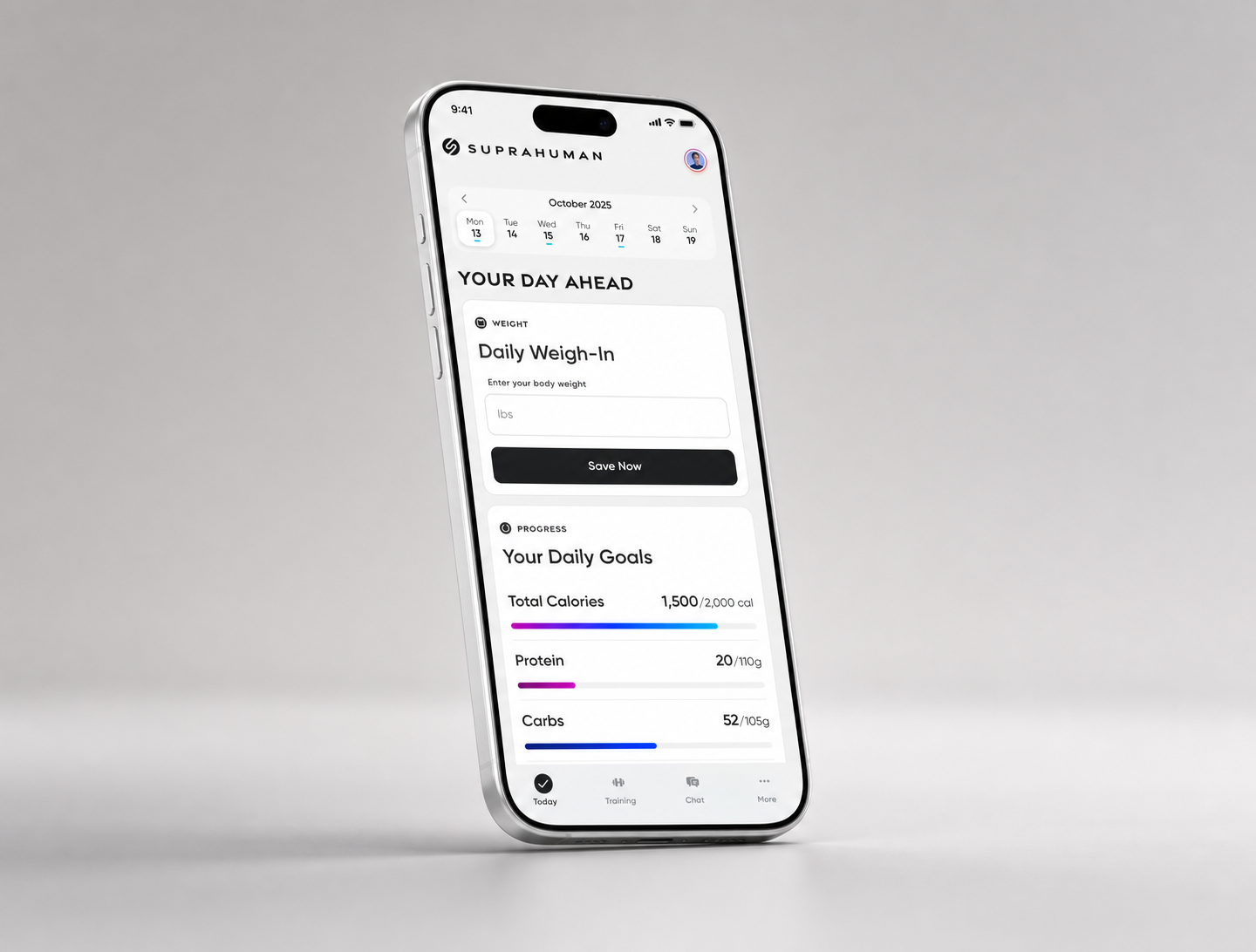
The current beta introduces the first layer of the connected Supra Human product experience.
Clients can begin entering an environment designed specifically around the way Supra Human delivers coaching, training, accountability, and progress.
What clients see today represents the beginning of the platform, not its final form.
Each screen will continue evolving as the product team gathers feedback, studies usage, and works with coaches and clients to improve the experience.

This Is Just the Beginning
Launching the beta was the moment the platform moved from something we were building behind the scenes into something real people could experience.
The conversations now become more specific. The feedback becomes more useful. The roadmap becomes more informed by how clients and coaches actually interact with the product.
We can see where the experience is working exactly as intended and where we have an opportunity to make it clearer, faster, or more valuable.
That’s what this stage is for.
We have built the foundation. Now we get to strengthen it, expand it, and continue shaping a platform capable of growing with Supra Human for years to come.
The beta is officially live.
And this is just the beginning.
If you haven’t read our CEO, Nineveh Madsen’s story behind the platform, take a few minutes to read her recent article on the WHY behind the platform and when more clients will be able to start using it.